
Actively growing pastures that are high in soluble protein have the potential to reduce growth rate potential in livestock.
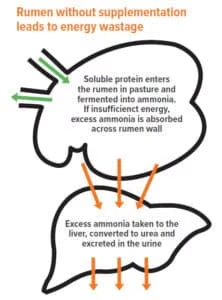
Soluble protein is the nitrogen in plants that has not yet been converted into true protein. Rumen microbes convert soluble protein into a form that can be used by the animal by converting it into ammonia and then using energy and ammonia to reproduce and create microbial protein.
During periods of active growth, pastures can be high in soluble protein and can flood the rumen. Very often there is insufficient energy (sugars and starches) to fuel microbial reproduction. This results in a large surge of ammonia in the rumen, and excess ammonia is absorbed across the rumen wall and transported to the liver, where it is converted to urea. It is either recycled via saliva, diffused into the bloodstream, or excreted in urine. This process requires the animal to expend energy to expel the excess and can negatively impact production targets.
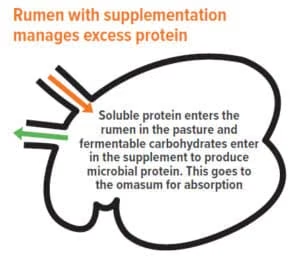
With supplementation of fermentable carbohydrates, microbes can capture more rumen ammonia, converting it into microbial protein.
Source: www.extension.psu.edu/protein-in-pastures-can-it-be-too-high
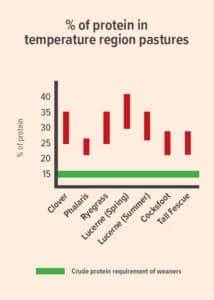
Weaners need a diet with 14-16% crude protein
There are many factors that contribute to the actual daily weight gain of livestock, and the exact amount of energy wasted in expelling excess protein is still to be quantified. However, the following formula can provide an indication of the magnitude of lost potential.
To calculate the reduction in daily weight gain, a feed test of the pasture is needed to evaluate: 1. Protein in the pasture, and 2. NDF (Neutral Detergent Fibre) of the pasture.
Formula: Reduced daily weight gain (g/day) = (Weight of animal (kg) x 1200 / Neutral Detergent Fibre (%)) x (Pasture protein (%) – Animal protein requirement (%)) x Energy waste to expel 1% excess protein for 1kgDM / Energy required to put on 1kg of live weight (MJ)
Example with sheep: Weight of animal 41kg. Neutral Detergent Fibre of pasture 31%. Protein of pasture 28.5%. Animal protein requirement 15.5%. Energy waste to expel 1% excess protein for 1kgDM 0.15MJ/kg*. Energy required to put on 1kg of liveweight 42MJ**. Reduced daily weight gain (g/day) = 41 x 1.2/0.31x (0.285 -0.155) x 0.15 / 42 = 74g per day
Example with cattle: Weight of animal 350kg. Neutral Detergent Fibre of pasture 29%. Protein of pasture 29.5%. Animal protein requirement 14.5%. Energy waste to expel 1% excess protein for 1kgDM of feed 0.15MJ/kg*. Energy required to put on 1kg of liveweight 42MJ**. Reduced daily weight gain (g/day) = 350 x 1.2/0.29 x (0.295-0.145) x 0.15 / 42 = 776g per day
Formula assumptions: *0.15 MJ is used to excrete each additional percent of protein within 1kg DM of pasture. **42MJ of energy is needed to add 1kg of LW to an animal
Learn more at advantagefeeders.com

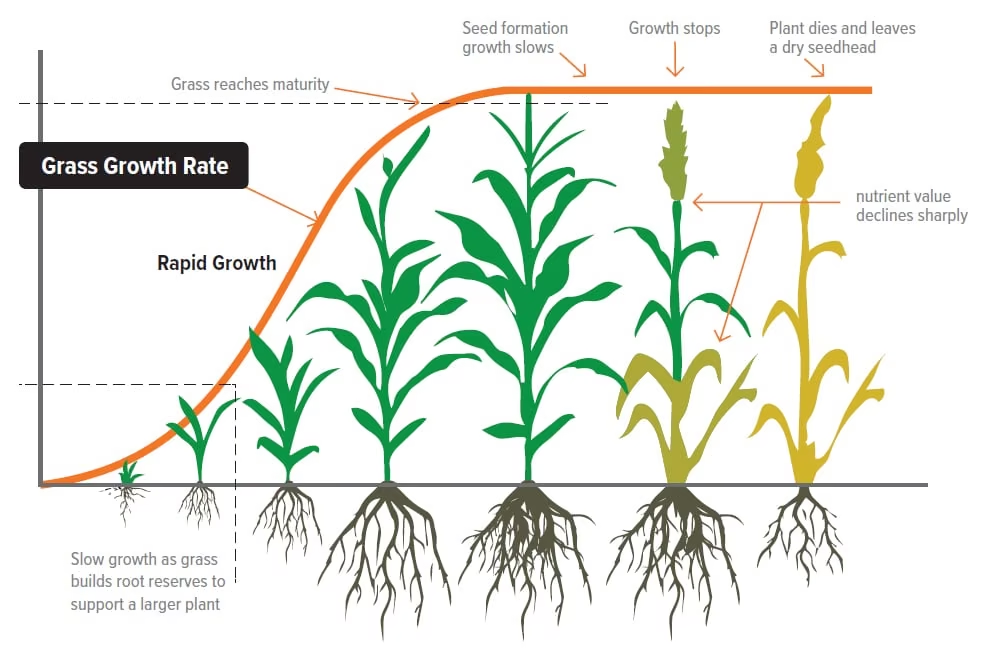
The period lasts as long as livestock are grazing lush, actively growing pasture that has high soluble protein.
Commencement: Supplementation commonly ceases when pasture growth overtakes pasture consumption. This usually corresponds with the ‘spring flush’ or ‘rapid growth’ stage. At this stage, pasture often has high soluble protein content, and if supplementation ceases, it can create an energy and protein imbalance.
Completion: Protein content in pasture typically deteriorates rapidly when the plant “goes to head” or reaches the “seed formation” stage.
The most profitable feeding rate is no more than the amount required to “manage” excess soluble protein. Feeding above this level when lush pasture is available will generally reduce profitability, as pasture is typically the cheapest feed source. In practice, Advantage Feeders experiments have demonstrated strong feed conversion efficiencies when supplementing at approximately 0.25% of body weight in fermentable carbohydrates.
Soluble protein levels in pasture vary throughout the season. A starting guideline is to feed between 0.25% and 0.33% of body weight, noting that this is general advice and nutritionist input is recommended for precise rationing.
If feeding at 0.33% of body weight, the following example amounts apply:
As a starting point, feed between 0.25 – 0.33% of body weight per day
As explained above, cereal grains are frequently used in this supplementary feeding application. If livestock are not adequately trained to the feeder and gorge on the supplement, this can lead to acidosis and may potentially be fatal.
Acidosis issues can be avoided if untrained livestock are first provided a safe feed, such as high-fibre pellets, in an ad-lib setting to encourage and reinforce feeding behaviour at the feeder. Once feeding behaviour is consistent, the ration can be transitioned to the cereal grain ration. While this process does involve some cost, it has consistently delivered strong results with minimal rumen upsets and only modest expense.
For a full explanation, see the Advantage Feeders User Manual, available to download from the website.
No training is needed for weaners that were creep fed before being supplemented to manage high protein pastures
The supplement fed should be high in fermentable carbohydrates such as cereal grains, as they are high in starch. The most profitable cereal grain option will depend on what is available on-farm and the relative cost of starch. (Source: www.extension.psu.edu/protein-in-pastures-can-it-be-too-high)
Feeding high-starch grains such as wheat should be introduced gradually. In this application, where the goal is to manage excess protein, only small amounts of feed are required. This means the 3-Way Restriction System on the feeders is typically close to, or fully, restricted, resulting in a lower risk of acidosis. Livestock must be trained to the 3-Way Restriction System before the feeder can be used in the fully restricted setting. Corn and sorghum are generally less effective than other cereal grains in this context, as a portion of their starch bypasses the rumen and is instead digested in the small intestines.
Formula: Price of starch (per tonne) = Price (per tonne as fed) / Starch density (% of feed of dry matter) / Dry Matter (%)
Examples:
In these examples, wheat has the most cost-effective starch, followed closely by barley.
Source: www.feedcentral.com.au
The amount of profit gained from managing excess protein depends on the benefit you receive from having heavier livestock.
From highest to lowest on most farms:

250 sheep per feeder or 50 cattle per feeder is recommended. This is a higher number of livestock per feeder than is recommended for any other application. When pasture is in the elongation and high-quality phase, livestock have ad-lib access to pasture and will choose to visit the feeder less frequently because the difference in feed quality between the complementary/supplementary feed and the pasture is marginal.
Like all applications, the number of livestock per feeder can be increased, but this also increases the risk of uneven consumption because there is more competition for trough space. This increased risk requires greater oversight and management to identify potential unevenness in feed consumption.
Source: The Wright experiment showed that 1 feeder for 400 lambs can have great results.
Controlling the ration to 0.33% of body weight is common. There are several experiments where the ration of weaned lambs and weaned cattle have restricted the ration to less than 0.25% of body weight when grazing lush pasture.
Sources:
Visit www.advantagefeeders.com to view our trial results.
Want to calculate the added profit from managing excess protein pastures? Visit our Ration Calculator.