Dry Feed Supplementation – Sheep
The benefit from feeding (little and often) from a feeder compared to trail or trough feeding once or twice per day.

Australian owned and trusted globally, Advantage Feeders is the most precise ration control feeders reducing feed waste and improving livestock production since 2007.

Share:

Explore More:

Dry Feed Supplementation – Cattle

The benefit from feeding (little and often) from a feeder compared to trail or trough feeding once or twice per day.

Feeding “once a day or every second day” means livestock must be provided with much larger amounts of supplement compared to when feed is offered through a feeder that they choose to visit 5–10 times per day. When livestock are provided with large amounts of supplemented cereal grain or feeds composed of cereal grain, microbes convert this fermentable carbohydrate into volatile fatty acids (VFAs), which supply energy to the animal.

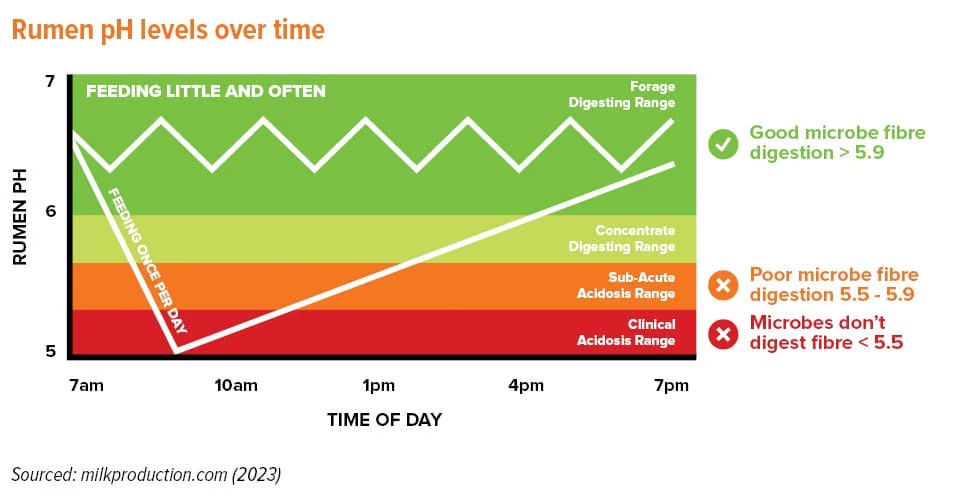
The conversion of fermentable carbohydrates into VFAs can lower rumen pH. When large amounts of fermentable carbohydrates are fed, the resulting VFAs and lactic acid reduce rumen pH. The optimal rumen pH level is between 6–7. When rumen pH drops below 6:

  1. The buffering capacity of the rumen is reduced and the efficiency of rumen flora and fermentation decreases.
  2. Appetite is suppressed for 1–2 hours, affecting feed intake and performance.

These rumen inefficiency issues mean that more supplement is required to meet production goals, leading to higher feed costs and reduced profit. However, when supplement is provided frequently and in small amounts, there is less fluctuation in rumen pH and rumen function can be maintained. This allows rumen microbes to ferment and extract more energy from cheaper feed sources such as pasture.

Other than rumen efficiency, there are a number of other benefits of using feeders compared to trail feeding:
  • No feed waste because feed isn’t put on the ground.
  • Reduced labour required to feed livestock, as feeders may only need to be filled less than once per fortnight.
  • Reduced vehicle costs because feeding is much less frequent.
  • No contamination of grain into areas allocated for future cereal crops.
  • Ewes tend not to run after the feeding vehicle, reducing the chance of mismothering.

Forage digesting microbes operate most efficiently when the rumen pH is between 6 and 7. (Sourced: milkproduction.com, 2023)

Less supplement feed is required when using the “little and often” system compared to trough/trail feeding

An experiment showed that when livestock are grazing dry pasture, the supplement requirement through the “little and often” system was 45% less than trail feeding every second day.

Please note that to achieve similar results, livestock must have access to enough dry pasture to keep their rumens full. If pasture is not available, livestock need to be provided with forages such as hay, straw, or silage to achieve similar results. Advantage Feeders hay feeders can provide systems to deliver these feeds with minimal feed waste.

Source: Leaver experiment available at www.advantagefeeders.com

The Leaver experiment showed that 45% less feed could be fed with the little and often system of the Advantage Feeders 3-way Restriction System

The period for feeding livestock to complement dry feed

This should be broken down into two components: the starting time and the finishing time.

Commencement. It starts when the quality of feed on offer does not meet your production goals:

  • For young livestock that require 14–16% crude protein to continue growing, this might start at the seed formation stage. This can be in October in temperate areas of Australia and April in sub-tropical areas.*
  • The quantity and timing of rain on plants after flowering will affect the quality of the pasture and its ability to meet the production goals of animals. Dry pasture has a component of sugar. The sugar contributes to a proportion of the energy of the feed. Rain can dissolve the sugar, and it can wash out of the plant, reducing the quality. The amount of rain needed to wash out the sugar depends on how much UV the plant has had – the more sun a plant has had, the less rain is required to reduce its quality, and the requirement for supplementary feeding becomes present. Dry pastures and stubbles can reduce substantially in quality by January.*
  • Livestock will selectively graze the best type of dry pasture, so the quality of the pasture deteriorates over time. Farms that have a lot of dry feed on offer, particularly those with stubbles after harvest, will have better quality dry feed for longer. It is common for mixed farmers with access to stubbles to have sufficient quality dry pasture until February.*

Completion. When there is enough new season pasture growth to meet production objectives: a common supplementary feeding period can be 150 days, starting in January for the temperate areas of Australia, and 180 days, starting in May for the sub-tropical parts of Australia.*

Please note:

  1. Weaned livestock may be complementarily fed in advance of the flowering stage of pasture to manage the excess protein of the pasture. It can be seamless, with minimum management required to transition from this application to the application of complementing dry pasture.
  2. New season pastures can be very high in moisture, with a fast passage through the rumen and potential animal health issues. Supplementing these types of pastures can slow rumen passage and reduce feed wastage so more animals can be grazed on a set amount of pasture. Again, it can be seamless and require minimum management to transition between the applications of complementing dry feed and managing high-moisture pastures.

*Disclaimer: This information is intended as a general guide and may be applied in other regions; however, timing, seasonal reference points, and pasture growth stages will vary depending on local climate, conditions, and farming systems. The above studies were conducted in Australia.

The best feed to complement dry forage

It is a complex evaluation. Livestock have requirements for energy, protein, minerals, and vitamins based on whether their objective is to put on weight, hold weight, or lose weight. Other factors include the pregnancy and lactation status of an animal and the quality and availability of paddock feed on offer. Consult a livestock nutritionist or farm consultant for expert advice.

Generally, energy is the limiting factor in a diet, and cost-effective sources are typically cereal grains and pelleted feeds.

How to work out the price of energy per MJ within different feed options: Price of energy (per MJ) = Price (per tonne as fed) / Energy density (MJ/kg of dry matter) / Dry Matter (%) / 1000

Examples:

  1. A sample of wheat is $360 delivered, it has 13.5MJ/kg of DM and the feed is 90% DM. The price of energy is $360 / 13.5MJ/kgDM / 90% / 1000 = $0.0296 per MJ
  2. A sample of barley is $330 delivered, it has 12.5MJ/kg of DM and the feed is 90% DM. The price of energy is $330 / 12.5MJ/kgDM / 90% / 1000 = $0.0293MJ
  3. A sample of oats is $350 delivered, it has 12MJ/kg of DM and the feed is 90% DM. The price of energy is $350 / 12.0MJ/kgDM / 90% / 1000 = $0.0324 per MJ
  4. A sample of pellets is $450 delivered, it has 13MJ/kg of DM and the feed is 90% DM. The price of energy is $450 / 13.0MJ/kgDM / 90% / 1000 = $0.385 per MJ

In these examples, the sample of barley has the most cost-effective energy, followed closely by wheat.

Please note that the pellets could be formulated to provide the other requirements of the livestock: protein, minerals and vitamins.

The cheapest source of energy can often be the best feed to provide livestock

Classes of livestock to provide a high return on investment

Any animal with a rumen offers a high return on investment. Any class of livestock that is grazing pasture and not meeting requirements to obtain production goals can be supplemented with the “little and often” system to achieve a profitable result.

The recommended supplementary feeding amount

There is a wide range in quantity required to be fed to livestock based on whether the objective for livestock is to put on weight, hold weight, or lose weight. Other factors include the pregnancy and lactation status of an animal and the quality and availability of paddock feed. Consult a livestock nutritionist or farm consultant for expert advice.

Common feeding ranges:

  • Ewes: 300-600g per day
  • Rams: 400-800g per day
  • Weaned cattle: 1-2kg per day
  • Cows: 2-4kg per day

Livestock per feeder in this application

The main factor that influences the number of livestock per feeder is the quantity of dry feed available to livestock. When livestock can achieve rumen fill, 200 sheep per feeder and 40 cattle per feeder is a general recommendation. When livestock don’t have access to enough dry pasture or forage, they will visit the feeder more frequently and the recommended livestock per feeder will reduce.

Like all applications, the number of livestock per feeder can be increased, but it increases the risk of uneven consumption because there is more competition for trough space. This increase in risk requires more oversight and management to identify potential unevenness in feed consumption.

Experiment livestocking rates per feeder:
  • Porter – 50 mixed sex weaned cattle per feeder
  • Marshall – 50 mixed sex weaned cattle per feeder
  • Leaver – 200 ewes per feeder

Please note: some smaller model feeders have different recommendations. Please view the specific product pages for more information.

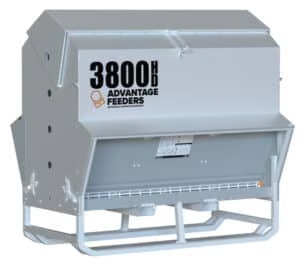
Recommend 200 sheep per feeder / Recommend 40 cattle per feeder

Want to calculate the return on investment from dry feed supplementation? advantagefeeders.com

Experiment rations with different feeds and livestock

  • Porter – 1.1kg per day of barley fed to mixed sexed weaner cattle
  • Leaver – 200g per day of barley during summer and then 400g per day of barley in autumn fed to mature ewes
  • Marshall – 0.8kg per day of sorghum fed to mixed sexed weaner cattle
  • Veale – 300g per day of wheat fed to mature ewes

Suggested minimum rations of different feeds

(Cereal grains / 4mm pellets / 6mm pellets — please note this is a guide only)

  • Mature sheep — 250 / 400 / 600
  • Weaned sheep — 150 / 250 / 350
  • Mature cattle — 2000 / 3500 / 5000
  • Weaned cattle — 1000 / 1750 / 2500

Minimum rations achieved from Advantage Feeders

There are a number of factors that influence the minimum consumption achieved with the 3-way Restriction System. For this application, the most important two factors are:

  • Size of the feed ration: The smaller the feed particle size, the more restricted the 3-way Restriction System can be set while still allowing an unimpeded feed flow. Please note that any trash in a sample can impede its flow.
  • Quantity of dry feed on offer: Without full rumen fill, livestock will visit the feeder more regularly and need to achieve rumen fill from the contents of the feeder.

Educating untrained livestock to the feeder

Cereal grains are frequently used in this supplementary feeding application. If livestock don’t have sufficient training to the feeder and gorge the supplement, this can lead to acidosis and potentially, be fatal.

Acidosis issues can be avoided if untrained livestock are provided a safe feed, such as high-fibre pellets, in an ad-lib setting to encourage and reward their feeding behaviour at the feeder. Once feeding behaviour is consistent, the ration can transition to the cereal grain ration. While this process comes at a cost, time and time again, it has proven to have great results with little cost and minimal rumen upsets.

For the full explanation, see page our User Manual, which can be downloaded from our website.

The Advantage Feeders Full Year Pasture Conversion System

Get the most out of your feeders year-round, for the best outcomes in every season. The ration control of our 3-Way Restriction System allows you to maximise your pasture, fodder and supplement conversion all year:
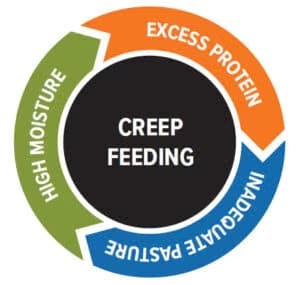
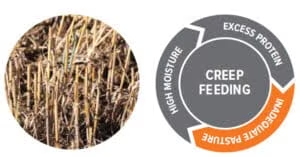
  1. With the natural life cycle of pasture, at times it will have inadequate energy and/or protein to meet your production goals. The Advantage Feeders 3-Way Restriction System gives you the tools to achieve production goals with labour and waste saving benefits while supporting the rumen to be more efficient in converting imperfect, but cost effective, pasture.

  2. When rain commences at the start of a growing season, pasture is often high in moisture and passes through stock too quickly to be fully absorbed. The Advantage Feeders innovative Hay Feeders, Grain Feeders and 3-Way Restriction System gives you the tools to slow rumen passage and better utilise more of the nutrients in the fresh pasture.

  3. During the growing phase of pasture, the soluble protein level is often much higher than required. In this period, the animal wastes a substantial amount of energy excreting excess protein in its urine. This wasted energy could alternatively be utilised for production. The Advantage Feeders 3-Way Restriction System gives you the means to eliminate this issue and to maximise your production.

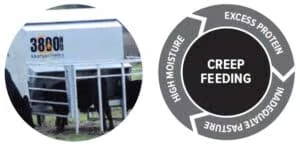
  4. Creep feeding is a system that develops the rumen of infant stock from non-functional to effective far quicker than consuming a diet of pasture alone. Compared to traditional systems where a cow or ewe consume pasture to produce milk to feed the young animal, creep feeding fast tracks the production system and quadruples pasture conversion.

Built tough for the paddock, backed by results